
Credit is often misunderstood — not because it’s complicated by nature, but because it’s rarely explained clearly. Our goal is to help you understand how credit actually works, what impacts it, and what realistic progress looks like over time.
There are no shortcuts, secret formulas, or overnight fixes. But with the right information and consistent habits, meaningful improvement is possible.
There are no shortcuts, secret formulas, or overnight fixes. But with the right information and consistent habits, meaningful improvement is possible.
What is a Credit Score?
A credit score is a number generated by a mathematical model designed to predict how likely someone is to repay borrowed money. Most scores range from 300 to 850.
Lenders use credit scores to help determine:
Whether to approve an application
What interest rate to offer
How much risk is involved
A higher score generally results in better loan terms and lower interest rates. A lower score often leads to higher costs — or denial altogether.
Lenders use credit scores to help determine:
Whether to approve an application
What interest rate to offer
How much risk is involved
A higher score generally results in better loan terms and lower interest rates. A lower score often leads to higher costs — or denial altogether.
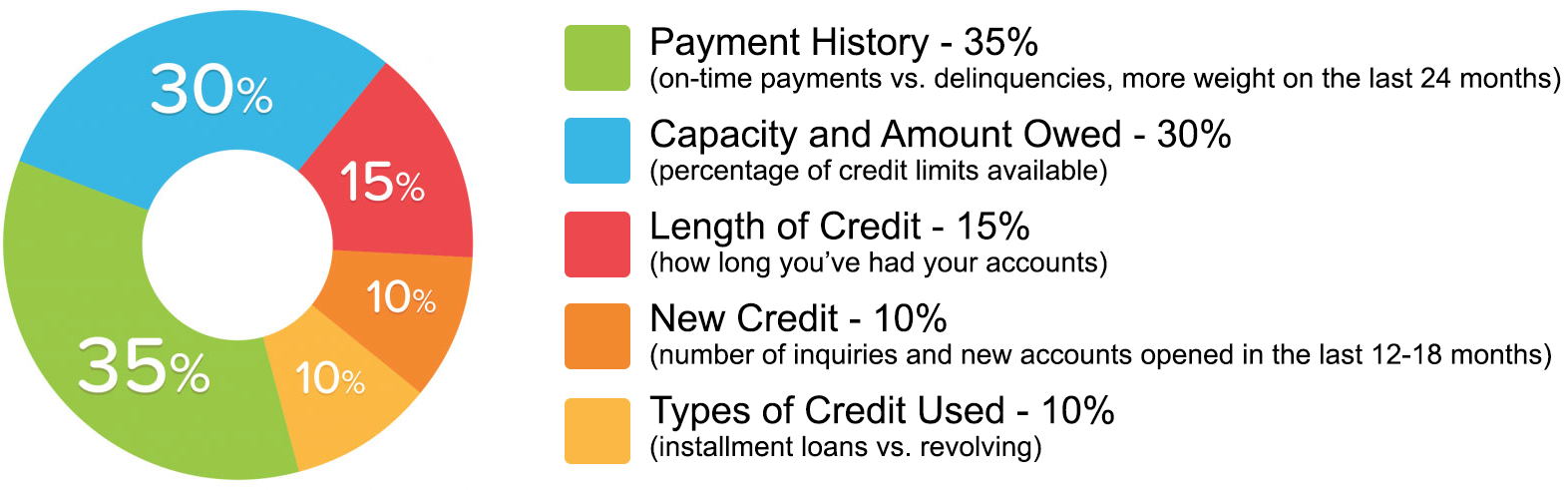
What affects your Credit Score?
A Realistic Perspective.
Credit improvement is not instant, guaranteed, or linear. Scores fluctuate, reports update over time, and results vary based on individual circumstances.
Education, patience, and informed decision-making create lasting progress — not pressure or promises.
Our role is to help you understand the process clearly so you can move forward with confidence.
Education, patience, and informed decision-making create lasting progress — not pressure or promises.
Our role is to help you understand the process clearly so you can move forward with confidence.
What Can You Do to Support Credit Improvement?
Credit improvement is a shared effort. While errors may be reviewed and disputed when appropriate, personal habits matter just as much.
Helpful practices include:
Progress takes time. Consistency matters more than speed.
Helpful practices include:
- Paying all bills on time, every time
- Keeping revolving balances as low as possible relative to limits
- Avoiding unnecessary credit applications
- Maintaining older accounts when appropriate
- Monitoring credit reports regularly
Progress takes time. Consistency matters more than speed.
How long will certain items remain on my credit file?
Most credit report items remain for a defined period under federal law:
- Late payments / delinquencies: Up to 7 years from the original delinquency date
- Collections: Up to 7 years from the original delinquency (paid collections may still appear)
- Charge-offs: Up to 7 years from the original delinquency
- Closed accounts (positive): Up to 10 years
- Bankruptcy:
- Chapter 7 & 11: Up to 10 years
- Chapter 13: Up to 7 years
- Judgments: Varies by state law
- Tax liens: Varies depending on status and resolution
- Hard inquiries: Up to 2 years (most impact occurs within the first year)
Information that cannot be in a credit report:
Certain information is not permitted to appear on a consumer credit report, including:
- Medical information (without consent)
- Outdated negative items beyond legal reporting periods
- Personal details such as race, religion, marital status, or age
- Employment inquiries (on consumer-facing reports)